

Parenting is one of the most meaningful things a person can do. But when the baby comes, nobody gives you a handbook. You figure it out as you go, and some days feel impossible.
Parenting challenges are real. They show up at every age and stage, from sleepless newborn nights to teenage arguments that leave you questioning everything.According to a Pew Research poll, 62% of American parents claim that parenting is more difficult than they anticipated. Additionally, 26% claim that it is “a lot harder.”

This guide covers the 10 most common parenting challenges that moms and dads across the United States face every day. More importantly, it gives you honest, practical ways to handle them. No perfect answers here, just real guidance grounded in experience and research.
1. Sleep Deprivation

Sleep loss hits hardest in the early years but does not stop there. Parents of school-age kids still deal with nighttime wake-ups and early mornings.Exhaustion is the outcome, which impacts your attitude, patience, and capacity for clear thought.
Establish a regular bedtime schedule for your kids. The brain is alerted to sleep by taking a bath, reading, and going to bed at the same time every night. One of the easiest and most beneficial adjustments a family can make for older children is to turn off devices at least an hour before bed. Explore screen time management strategies that match your child’s age.
2. Parenting Challenges With Discipline
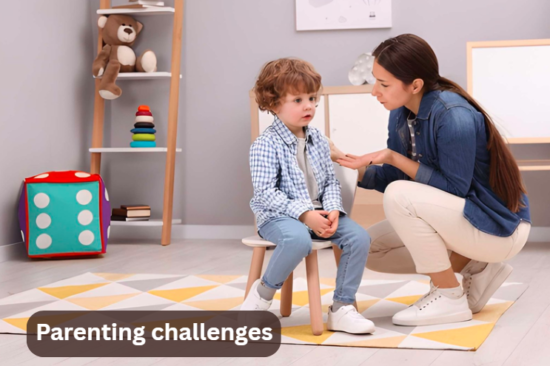
Discipline is one of the most debated parenting challenges in America. Yelling and harsh punishments often make behavior worse over time. A study in the Journal of Child Development found that children who are frequently yelled at develop lower self-esteem and more behavioral problems.
Positive parenting focuses on connection before correction. Set clear, age-appropriate expectations and follow through consistently. When your child’s behavior frustrates you, pause before reacting. Then respond with a short, direct statement about what is not acceptable and what the consequence will be.
3. Screen Time and Technology

Screens are everywhere and they are not going away.Screen time has emerged as one of the most difficult everyday parenting issues for a lot of parents. Kids want more of it. Parents are not sure how much is too much.
Not all screen time is equal. A child video-chatting with a grandparent is different from passively watching YouTube for three hours. Build structure around screens rather than fighting a constant battle. Set designated screen time windows, keep devices out of bedrooms, and create tech-free zones at the dinner table.
For early childhood education , screens can be a valuable tool when used with purpose. Watching an educational show together and talking about what you see turns passive watching into active learning.
4. Work-Life Balance and Burnout

Work-life balance sounds simple but feels impossible in practice. Many American parents are working longer hours while also trying to be more present with their children than ever before.
There is genuine tension. You are thinking about your children at work, which makes you feel bad. You are thinking about work at home, which makes you feel bad.Research shows that parents who experience positive spillover between work and home life show significantly lower rates of burnout.
Be completely at home when you are at home. At supper, put down your phone. When you go to bed, be there.Even one hour of real, distraction-free connection daily is more valuable than five hours of half-present time.
5. Tantrums and Emotional Outbursts

Tantrums are one of the most visible parenting hurdles and one of the most misunderstood. For young children, a tantrum is usually a brain issue, not a behavior problem. It takes until the mid-20s for the area of the brain responsible for controlling emotions to reach full development. Young children are not manipulating you when they melt down. They are genuinely overwhelmed.
During a tantrum, get low and quiet. Speak in short, soft sentences. Do not try to reason until the emotional storm passes. After it is over, name what they felt. “You were really frustrated when we had to leave the park.” Over time, these conversations reduce the frequency of outbursts.
6. Communication Breakdowns

Many parenting issues come down to communication. Parents want their children to open up. Kids, especially teenagers, go silent. A youngster retreats more when a parent pushes.
The most common mistake is turning conversations into interrogations. Open-ended statements work better than rapid-fire questions. Listen without immediately solving. When a child shares a problem, most of the time they just need to feel heard. Ask “Do you want advice or do you just need me to listen?” That one question usually leads to a much more open conversation.
7. Parenting Challenges From Different Parenting Styles

When two parents have fundamentally different parenting styles , children get mixed signals. One parent is strict about screen time, the other lets it slide. The inconsistency creates confusion for children and tension between parents.
The best results are regularly produced by authoritative parenting, which is warm but has clear expectations.When parents disagree, the conversation needs to happen away from the children. Find common ground on the non-negotiables and present a united front even when you see things differently.
8. Social Struggles

Watching your child struggle socially is painful. The natural tendency is to intervene and make things right. However, over engagement frequently exacerbates the issue.Social skills are learned through experience, including the experience of navigating conflict and disappointment.
What helps is coaching, not rescuing. After a difficult social situation, ask your child what happened and what they think they could do differently next time. Practice what to say when someone is unkind. Give your child language and strategies, then let them try.
9. Parental Guilt and Self-Doubt

Parental guilt is one of the least talked about but most universal parenting challenges. Almost every parent wonders at some point if they are doing enough or if their choices are somehow damaging their children.
Social media makes this worse. What you see online is not real life. Guilt is often a signal that you care, not that you are failing. When guilt shows up, ask yourself whether the concern is realistic. If there is something real to address, address it. If it is comparison-driven, let it go.
Following a parenting mom life approach means building a community of real parents who are honest about struggle and supportive without judgment.
10. Raising Confident, Resilient Kids

Every parenting challenge you face connects to one deeper goal.You want your child to be nice, competent, and self-assured.Confidence is not built by telling children they are special. It is built through experience, through trying hard things, failing, and trying again.
Protect your child from serious harm. But do not protect them from difficulty. Let them struggle with the homework problem before you solve it.Allow them to experience the inevitable fallout from forgetting their meal.These small experiences compound into resilience over time.
The fpmomparenting reminds us that parenting is not about raising a perfect child. It is about raising a prepared one.
Final Thoughts

Nobody gets through parenting without a few hard days. Or a lot of them.
There will be mornings you lose your patience before 8am. There are nights when you relive a conversation and wish you had acted differently.Moments where you genuinely wonder if you are cut out for this.
That isn’t a failure. From the inside, something appears just like that.
The parents who struggle with these parenting hurdles are not the bad ones. They are usually the ones trying the hardest. The ones who feel nothing are not paying attention.
So give yourself a break. Not a pass on the hard work, but a break from the idea that every other parent has figured something out that you have not. They have not. They are just quieter about it.
Show up tomorrow. Try a little differently. That is the whole job. Read more about parenting at https://momlifefamousparenting.com/